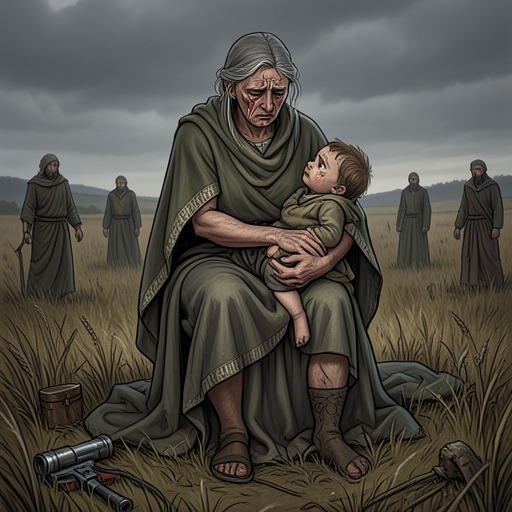
Tess's child
Tess of the d'UrbervillesTess’s child, known as Sorrow, is the infant whose short life makes the consequences of Tess’s social exclusion painfully concrete. His birth has made Tess a target of village judgment, yet when he falls ill her concern is not for her own reputation but for preserving his life and securing the baptism she believes he needs. The child’s death therefore joins intimate maternal grief to the pressure of religious teaching and family shame: even in a household with no access to a willing parson, Tess struggles to keep her son from being condemned for the circumstances of his birth.
Identity and Background
The child is born to Tess after her return from Trantridge, and his existence gives a lasting, visible consequence to an episode his mother had been too young and inexperienced to understand. When Tess confronts her mother’s reproach, she says she was a child herself when she left home and that nobody had warned her of the danger men could pose. Her mother, by contrast, had hoped the relationship might secure a marriage and material benefit for the family. Their disagreement shows the unequal meanings attached to the infant’s birth: for the adults around Tess, it is bound up with sexual reputation and household prospects; for Tess, it becomes a responsibility toward a living child.
At the harvest meal, Tess’s older sister brings the infant to her in long clothes while the workers pause to eat. The child is physically dependent on the young mother who has returned to field labor, and Tess takes him from her sister to nurse him. The scene places motherhood not in a protected domestic setting but among the shocks and stubble of a working field, where Tess must pause from labor to feed her baby.
Motherhood in Public
Tess initially sits apart, turns her face somewhat away from the other harvesters, and declines a man’s offer of ale. She calls her sister over and begins suckling the child with a movement described as both stealthy and courageous. The men nearby turn their faces away, while the other women talk among themselves. Their consideration gives Tess a brief measure of privacy, but it does not remove the visibility of her situation: the child’s presence marks her as a mother outside marriage in a community that has already made her a social warning.
After the infant has fed, Tess sits him upright in her lap and dandles him while looking into the distance. Her expression suggests gloomy indifference, almost dislike; then, abruptly, she kisses him again and again with such force that he cries. The reversal gives the scene its emotional truth. The child is not simply a symbol of disgrace or an uncomplicated source of comfort: Tess’s strained response moves between the weight of her circumstances and an attachment too powerful to conceal. A woman among the harvesters recognizes that Tess is fond of him even when she says she wishes they were both in the churchyard. The child’s presence thus draws out both the community’s gossip and its recognition of a maternal bond.
Illness and the Crisis of Baptism
That evening, after a day in the fields and a ride home with the harvesters, Tess learns that the baby has suddenly become ill. His frame is tender and puny, and the narrator presents the collapse as foreseeable without making it any less of a shock. The infant’s vulnerability changes the meaning of the social stigma surrounding his birth: the question is no longer what his existence says about Tess, but whether he will survive.
As his condition worsens, Tess’s wish to preserve him overwhelms any passive acceptance of the condemnation directed at her. She fears that the child is dying without baptism. Her own anticipated punishment has seemed to her something she must endure, but the prospect that her baby might die without salvation is different. The child’s unbaptized state turns inherited religious teaching into an urgent, personal terror, intensifying her grief beyond the prospect of bereavement alone.
Near bedtime Tess asks to send for the parson. Her father refuses: having just returned from his weekly drinking at Rolliver’s Inn, he is especially sensitive to the shame Tess’s situation has cast on the family’s claimed nobility. He says no parson should enter the house to pry into their affairs and locks the door, keeping the key in his pocket. His decision makes family reputation an immediate barrier between the dying child and the religious rite Tess seeks for him.
Death and Narrative Significance
After the household has gone to bed, Tess repeatedly wakes and discovers in the middle of the night that the infant is worse. He is plainly dying, quietly and without apparent pain. Alone with the crisis, Tess imagines the child condemned to hell both for lack of baptism and for illegitimacy, drawing on the frightening religious imagery taught to young people. The scene shows how doctrine, rather than offering consolation, sharpens her distress: she pictures an infant subjected to torment because the adults and institutions around him have not provided the rite she believes necessary.
The child’s brief life binds together economic dependence, sexual stigma, maternal responsibility, and religious authority. Tess must return to harvest work, and the workers’ lunch break becomes the setting in which her care is exposed to communal observation. Later, her father’s concern for family shame prevents her from summoning the parson. The infant is therefore affected by forces he cannot understand or control: poverty shapes the circumstances of his care, social judgment attaches itself to his birth, and religious rules make his lack of baptism a source of fear as death approaches.
In Angel’s later judgment of Tess, he acknowledges that she was more sinned against than sinning, but says forgiveness is not enough to resolve what has happened between them. That recognition does not undo the earlier losses or the shame that surrounds her motherhood. The child’s role in the novel is brief but decisive: through his dependence and death, the cost of treating a woman’s sexual history as a moral stain becomes visible in the life of her infant as well as in her own.